If you are looking for fast growing privacy hedges in Utah, there are several hedges that come to mind.
While many of these are great options in the right circumstances, they are not always the best choice for every situation. This post shares which plants are the best fit for your landscaping solution.
Glover Nursery will walk you through the best trees & shrubs to use for your specific circumstances. We’ll discuss water needs, soil fit, easy care, and the desired year-round aesthetic to fit your garden.
Factors To Consider When Choosing a Privacy Hedge
Choosing the right privacy hedge in Utah isn’t just about looks, it’s about selecting plants that can handle our unique climate and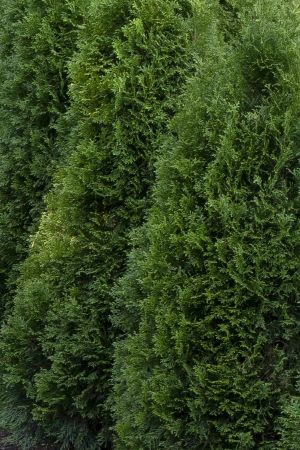
thrive for years to come. Utah has unique soil and climate conditions that make growing plants that are easier in other states somewhat challenging here.
The same plant (Emerald Green Arborvitae, for example) might grow fairly quickly in a climate with more rainfall, higher humidity, and lower-to-neutral pH soil, such as the Midwest, Northwest, or East Coast.
Utah’s dry climate, intense sun, and alkaline soil make it tough for many common plants to thrive—often limiting their growth to about 75% of their expected size.
Plant information found online is often tailored to generic ideal conditions. Factors such as mature size, growth rate, and sun requirements are standardized and may not be realistic in our state.
A Few Questions To Ask Yourself
At Glover Nursery, we’ve spent decades growing plants in Utah’s unique conditions, so we know what actually works. Before you start shopping, take a minute to think through the following questions to discover what you really need from your privacy hedge.
Some questions worth asking before choosing your plants:
- What is the sun exposure in this area? Hot and sunny? Partial or full shade?
- Do you have secondary water sourced from Utah Lake which has a higher salt content?
- How much width is available for the mature size of the plant? Is it being planted only a foot away from a fence or house, or is more space available?
- Have you tried other plants in this area before that haven’t worked?
Water availability matters most here. Some plants on this list are drought-tolerant once the root system is fully established, while others need more consistent moisture through the growing season for the life of the plant. Sun and shade also play a role, as a few popular options actually prefer afternoon shade.
It’s also important to know the type of water you use in your landscape. Secondary water from Utah Lake is significantly higher in salt content, which affects the long-term health of your plants. We recommend starting with our list of plants that can tolerate alkaline conditions before browsing the hedge options below. It’s disappointing to set your heart on a specific plant only to discover it won’t survive due to your water source.
As always, it is helpful think through your site conditions and landscape goals before purchasing. After that, a second round of questions will help narrow down what type of hedge suits your yard:
- How tall does your screen need to be?
- Does your screen need to be evergreen, or can it be deciduous?
- Do you want a full, solid screen or can there be gaps between plants?
- Do you want all the same plant, or can you alternate evergreen and flowering or deciduous plants for a more natural look?
Why Not Just Plant Arborvitae?
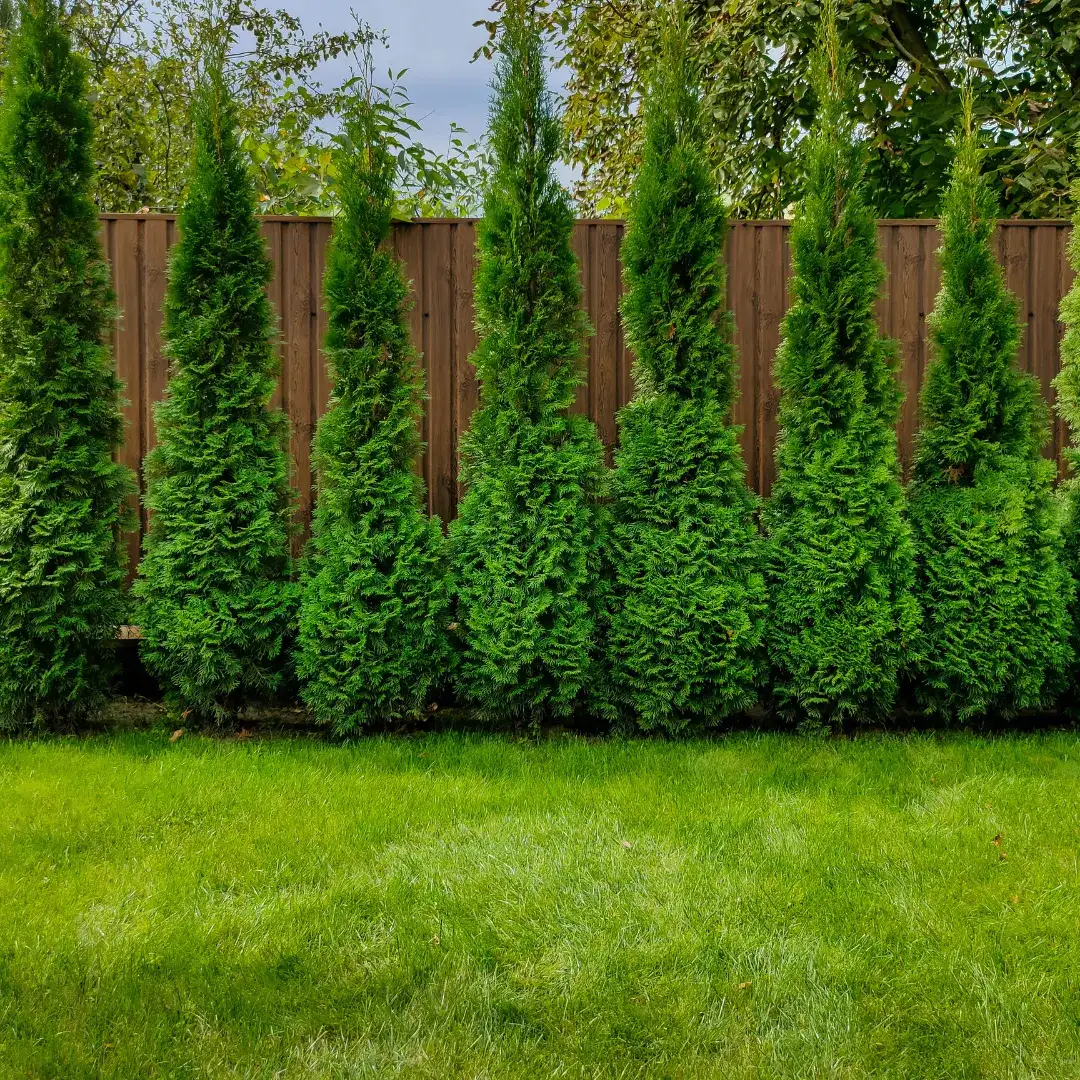
Arborvitae deserves its reputation as an excellent choice for a privacy hedge. It stays green all year, is naturally upright with dense, lush foliage, and certain varieties put on significant growth within a few seasons. It will deliver perfectly, but only under favorable conditions.
Unfortunately for many of us in Utah, the dense clay soil, alkaline conditions, and high salt content of some water sources will lead to a rather fast end to that dream of an Arborvitae privacy hedge.
Why Arborvitae Struggles in Utah
While Arborvitae can do well on the benches around Salt Lake Valley, in the lower parts of the former Bonneville lakebed it’s not usually the best fit. Soils on the valley floor tend to be heavier clay with more alkalinity, and Arborvitae will struggle in those conditions.
Arborvitae is also very sensitive to the high salt content of Utah Lake’s secondary water. If you’re using that for your landscape, it’s not going to be the right choice. Even if you use culinary water on them, the high salt levels already present in the surrounding soil from secondary water use can still affect their long-term health.
On top of that, Arborvitae isn’t drought-tolerant. Sprinkler irrigation alone won’t keep it properly hydrated. It needs deep, slow soaking throughout every season and even through the winter months.
Additionally, the transpiration rate is quite high due to the tiny, fine needles that make up the lush foliage. This process continues year round, even in the winter months, which makes Arborvitae prone to severe winter die-back without the correct water application to support it through those months.
If you have culinary water and sandy or loamy soil, Arborvitae can work well in your yard. If you don’t, the plants listed below will perform better with significantly less effort.
Evergreen Privacy Hedges
Year-round screening is the main reason people seek out arborvitae. The Evergreen options below give you that same consistent coverage while being better suited to the clay soil and alkaline conditions many Northern Utah yards present.
Upright Junipers are the go-to selection when Arborvitae are not the right fit. They are the closest in terms of shape and height available, and can grow well in nearly every condition we have here in Utah landscapes, including the alkalinity of secondary water.
Junipers are slower growing, but they can tolerate heat, drought, clay, and alkaline conditions. In fact, the blue-hued Rocky Mountain juniper varieties (Blue Arrow, Blue Point, Medora, Moonglow, Skyrocket, and Wichita Blue) are native to Utah. These make them an excellent option for Northern Utah’s landscapes.
Many varieties are hardy to Zone 4, and others to Zone 5. Be sure to check your local USDA zone to ensure the right plant for your landscape if you are in a higher elevation area.
Some of the most popular upright Junipers are:
| Over 10’ | Height | Width |
| Blue Arrow Juniper | 12-15’ | 2-3’ |
| Blue Point Juniper | 12’ | 8’ |
| Hollywood | 15’ | 10’ |
| Medora | 10’ | 2-3’ |
| Moonglow | 18-20’ | 8’ |
| Rocky Mountain Juniper | 30’ | 10’ |
| Skyrocket | 15-20’ | 2-3’ |
| Spartan | 12-15’ | 3-5’ |
| Taylor Juniper | 25’ | 3’ |
| Trautman | 12-15’ | 2-4’ |
| Woodward | 18-20’ | 2-4’ |
| Wichita Blue | 10’-15’ | 4’-6’ |
| 4-6’ | Height | Width |
| Angelica Blue | 3-5’ | 6-8’ |
| Gold Cone | 4’ | 1-2’ |
| Mint Julep | 4-6’ | 6-8’ |
| Montana Moss | 4’ | 5’ |
| Pencil Point | 5’ | 1’ |
| Sea Green | 4-6’ | 4-6’ |
We also carry a wide selection of ground cover junipers, but as this blog is about hedges, we won’t include them here. Feel free to check our catalog for more information.
If you are interested in something other than Junipers, the following are lesser-known hedge recommendations that offer some very beautiful options, depending on your goals and needs.
Columnar Norway Spruce (Cupressina) and Columnar Wellspire Spruce
These evergreen trees grow to similar sizes, about 20’-25’ tall and 4’-6’ wide in 20 years, and are known for their slender habit and upright branching structure. They’re great options for high elevation as they are hardy to Zone 3b.
They can add a formal look to a garden space, but look best with some spacing in between each tree. Spruces also prefer well-draining, moist soils and culinary water.
Columnar Blue Spruce (Picea pungens ‘Fastigiata’ or ‘Iseli Fastigiate’)
Another evergreen option for a privacy hedge is the columnar form of our native Colorado Blue Spruce. These powdery blue conifers grow slowly to between 15’-20’ tall and 3’-5’ wide with stiff needles and upright branches.
Like all spruces, they prefer moist, well-draining soil and don’t like secondary water.
Gracilis (aka Slender) Hinoki Cypress – grows to a maturity between 10-15’ tall and 6-8’ wide. Dark green sprays of foliage; open, irregular shape. Not tolerant of hot sun, so would need dappled shade in the afternoon.
Leyland Cypress – is known for its fairly fast growth (with regular irrigation), sun & heat tolerance, and ability to be pruned into neat hedges. This makes it a practical choice when getting coverage established quickly is the priority. They do get quite wide and require more hedging and maintenance.
Leyland Cypress and varietals are also great choices; they include Emerald Isle ®, Gold Rider, and Leyland Shorty.
Arizona Cypress is another excellent evergreen option for drought tolerance and high heat conditions. These trees are often grown as individual specimens, but can be grown together to make very resilient tall screens for tough areas.
Hicks Yew grows 8 to 10 feet tall and 3 to 4 feet wide, with dense dark green needles that hold their color through all seasons. It adapts to both sun and shade, making it one of the more flexible options for yards that don’t get consistent light. It prefers well-draining soil and moderate water.
Manhattan Euonymus – looks formal even without pruning. It grows 6 to 8 feet in both height and width, handles alkaline and well-draining soil comfortably, and is salt-tolerant. It likes afternoon shade, which makes it a practical choice in areas where secondary water or road treatment has raised soil salinity. Euonymus is highly susceptible to deer browsing, so take that into consideration if you live in an area with a large deer population.
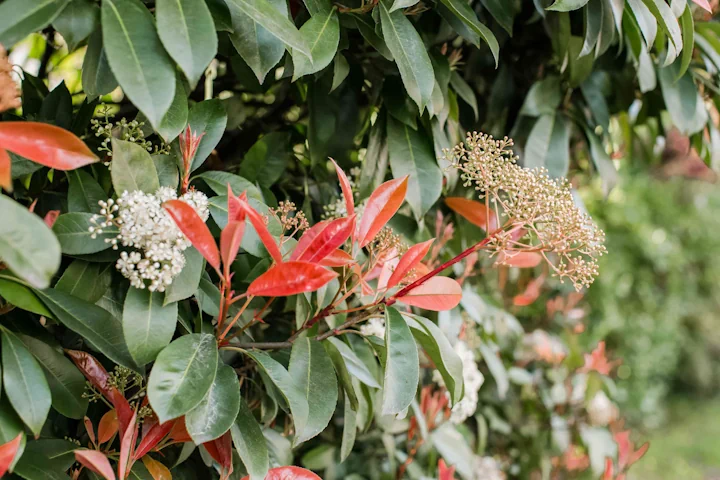
Red Tip Photinia – grows fast, reaching 8 to 10 feet tall and 6 to 8 feet wide. It pushes bright red new growth each spring alongside white flowers, making it one of the more visually interesting evergreens on this list. It handles alkaline soil, is drought-tolerant once established, and performs well in afternoon or full shade.
Pyracantha – offers year-round coverage plus vivid orange berries that persist through winter. The Yukon Belle variety grows 8 to 10 feet tall and 6 to 8 feet wide, with white spring flowers and fast growth. It’s deer-resistant, and the thorns make it an effective barrier. But pruning requires care.
Silver King Euonymus – a good fit when your space tops out around 6 feet. The green leaves edged in creamy white brighten shady spots well. It grows 6 to 8 feet tall and 3 to 4 feet wide, tolerates poor soil and reflected heat, and is salt-tolerant.
Laurel – offers dense coverage in situations where direct sun is limited, staying under 6 feet and working well where taller evergreens would be too much.
Deciduous Options
Deciduous hedges lose their leaves in winter, but don’t let that put you off. Through Utah’s growing season, they provide lovely foliage and dense, effective screening. Here are several of the best deciduous options that are also available in our nursery:
Cheyenne Privet – grows 8 to 12 feet tall with a dense, upright habit and handles pruning well. It sports a glossy, emerald-green foliage throughout the season, and fragrant white flower clusters appear in the summer. It’s fast-growing, drought-tolerant once established, deer-resistant, and performs well in alkaline and poor soils.
Straight Talk Privet – reaches 10 to 12 feet tall but only spreads about 2 feet wide. That makes it useful when space is tight, or you want a vertical accent without much footprint. It tolerates the Northern Utah droughts and colds, performs across a range of soil types, and is deer resistant.
Tallhedge Buckthorn – grows 12 to 15 feet tall while staying just 3 to 4 feet wide. It’s a genuinely columnar habit that works well when you need real height without losing yard space. It handles alkaline soil and low water once established, though it can self-seed, so check whether that’s a concern in your area.
Fine Line Buckthorn – a softer, more ornamental option with distinctive fern-like foliage that turns warm yellow in fall. It grows 5 to 9 feet tall with a narrow 2 to 3 foot spread, handles alkaline soil and low water, and performs well at higher elevations.
Peking Cotoneaster – grows 6 to 10 feet in both height and width, making it a natural, informal screen rather than a clipped hedge. In the fall, the foliage turns brilliant orange-red while black fruit ripens at the same time. It handles salt, heat, and drought well once established.
Rose of Sharon, Columnar varieties – grows as an upright deciduous shrub and produces flowers late in the season when most other shrubs have finished blooming. If you want a privacy hedge with sustained visual presence through summer and into fall, it’s a strong option.
Shorter Hedges
Tall privacy hedges are not always the answer. A lower hedge can define a space, soften a boundary, or add structure to a planting area. Here are five of the best shorter privacy hedges to plant in Utah:
Lodense Privet – a dense, dwarf deciduous shrub that responds well to pruning and works naturally as a low formal hedge. Left unpruned, it produces lightly scented white flowers in early summer, with dark green foliage that holds late into fall.
Boxwood – an evergreen shrub that holds its shape well and responds reliably to shearing. It grows slowly, which keeps maintenance manageable, and it works in full sun to partial shade with well-draining soil.
Knock Out Roses – grow 3 to 4 feet tall and wide, are disease resistant, heat tolerant, and self-cleaning, so deadheading isn’t required. They come in a wide range of colours and work well along a fence line wherethe hedge needs to pull its visual weight too.
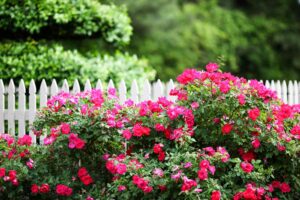
Easy Elegance Roses – one of our favorite roses in the nursery. This is an everblooming hybrid shrub rose that rarely exceeds 4 feet tall and wide. They’re disease-resistant, drought-tolerant once established, and attractive to bees, butterflies, and hummingbirds.
The whole series is own-root, which avoids the suckering issues common with grafted varieties.
Iceberg Roses – blooms continuously from spring through to winter, producing clusters of soft white double flowers. They’re fairly drought-tolerant once two growing seasons are behind them and are available in floribunda, climbing, or shrub forms.
Flowering Shrubs
These plants make effective privacy hedges. However, they bloom on old wood. Prune at the wrong time, and you’ll remove the following season’s flowers. It’s best if you start pruning right after they finish blooming to keep their shape.
Burkwood Viburnum – grows 8 to 10 feet tall with fragrant white spring flowers and dark green foliage. It’s tolerant of shade, heat, cold, and pollution, performs well at higher elevations, and is easy to care for in yards that don’t offer ideal conditions.
Arrowwood Viburnum – grows 6 to 10 feet tall with a rounded, upright habit. It produces white flowers in spring, blue-black berries in fall that birds find irresistible, and fall colour ranging from yellow to red. It tolerates a wide range of soil conditions and is deer-resistant.
Korean Spice Viburnum – grows 4 to 6 feet tall with fragrant pink flowers that turn white in spring and bright red berries that age to black in fall. The foliage turns red and burgundy as the season closes. It draws bees, butterflies, and hummingbirds.
Lynwood Gold Forsythia – grows 6 to 8 feet tall and wide, with deep yellow flowers arriving in early Spring before the leaves appear. It’s fast-growing, salt-tolerant, and looks best when allowed to keep its natural arching shape rather than being sheared square.
Korean Lilac – reaches about 5 feet tall and wide with fragrant lavender-pink flowers in late spring. It blooms later than other lilacs, is fast-growing, heat-tolerant, and salt-tolerant.
French Lilac – grows 10 to 12 feet tall and 8 to 10 feet wide with dense, fragrant double lavender-purple flowers in mid-to-late spring. It handles alkaline soil and low water once established, making it a strong option for taller screening with real seasonal impact.
Columnar Trees for Taller Screening
There are a lot of great trees to plant in Utah. But when your goal is, columnar trees are worth considering. They grow tall with a narrow footprint, which makes them practical where space along a boundary is limited.
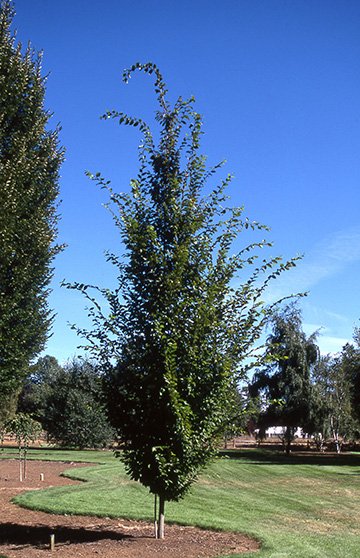 Dawyck Purple Beech – a striking columnar tree with rich purple foliage that holds through the growing season before shifting to red tones in fall. It’s an extremely upright form and is well-suited to northern Utah conditions.
Frans Fontaine Hornbeam – tolerates heat and drought once established, handles a range of soil types, and produces dense, bright green foliage through the season with golden yellow fall colour. Its natural columnar habit makes it ideal for tall screens, and it handles pollution well.
Columnar Oak – takes a slower approach to tall screening. Its tight, narrow form and dense foliage create a structured vertical presence, and it’s resistant to mildew. For a long-term planting where permanence matters more than pace, it rewards the wait.
Slender Silhouette Sweetgum – a narrow upright tree with distinctive foliage that brings seasonal character to a tall screen. It’s a good fit when you want height with some visual interest through the seasons.
Explore Privacy Hedge Options With Glover Nursery
Most of the plants on this list are less demanding than arborvitae while still providing the same privacy. Some will give you flowers, color, or even wildlife activity on top of that. Not a bad trade!
If you’d like to view these plants in person, our plant nursery is always open for walk-ins. Just head on over to Glover Nursery and talk to one of our staff for personalized recommendations. We can also deliver with our tree planting and delivery service.
FAQs About Privacy Hedges
How long does it take to grow a privacy hedge?
It depends on the plant, as they all have different growth rates. Many hedges reach meaningful screening height within three to five years.
Fast-growing options include Arborvitae, Leyland Cypress, Euonymus, Privet, and Hornbeams.
For shorter hedges, Lilacs, Photinias, Roses, and Rose of Sharon make great choices.
The care you put into properly establishing the root system during the first two growing seasons makes the biggest difference to how fast a hedge fills in, as well as how successful it will be in the long run. Be sure to read our recommended watering protocols to help your plant set strong and deep roots.
What is a good fast-growing privacy hedge for Utah?
Fastest growing hedge plants include Hornbeams, Privet, and Leyland Cypress.
Arborvitae grow moderately in Utah conditions, though they may not be the right fit for secondary water conditions. Junipers, which are a better fit, are slower-growing but will have more success in the long run.
How much does a privacy hedge cost?
Cost varies depending on plant species, size at purchase, quantity, and whether you’re planting it yourself or having a landscaper do it for you. Ongoing costs should typically include water and the occasional fertilizer.
We recommend visiting us here at Glover Nursery to get a good look at the trees & shrubs in this list. If you already know which plants you would like, feel free to send us a Plant Quote Request, and we’ll be happy to send you the current pricing.
Where can I buy privacy hedges in Utah?
Glover Nursery carries a wide range of privacy hedges intentionally selected for their performance in Utah’s soil and climate. Our expert gardening team can help you choose the right plant for your specific site.
What are the best shrubs for privacy in Utah?
The best shrubs for privacy in your yard will depend on your specific site conditions. It is important to know what type of water source you have as a starting point, whether it’s culinary or secondary, and then what type of soil you have.
In general, the option that suits the most conditions in Northern Utah is upright Junipers, but as we have shown above, there are many options available that might better suit your aesthetics and landscape goals.
Give us a call or come down and see us. We can help you find exactly what you need for the perfect privacy hedge.
Do you need to wrap privacy hedges in the Winter?
Another consideration for privacy hedges is winter wrapping.
Plants that have long, upward growing branches, including Arborvitae and Junipers, are susceptible to breakage during heavy snow storms. To protect your trees, we recommend wrapping certain trees with burlap throughout the winter.